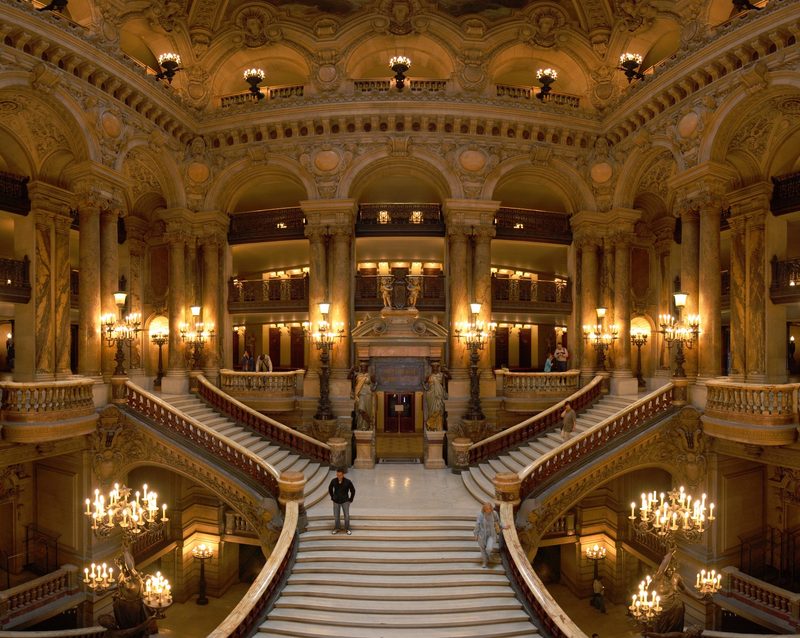
The Paris opera house, and the emblem of Beaux-Arts eclecticism under
Napoleon III’s Second Empire. Charles Garnier was young and unknown when
he won the 1861 competition against the regime’s favourites. He mixed
Italian Baroque, French Neoclassicism and heavy sculptural decoration
(polychrome marble, gold, allegories) with the newest engineering of the
day: a metal frame, kept out of sight. The great foyer, the monumental
staircase and the red horseshoe auditorium with its 8-tonne chandelier
set the pattern for the 19th-century “bourgeois opera house”. It is the
setting of The Phantom of the Opera.