
Painting · bridge
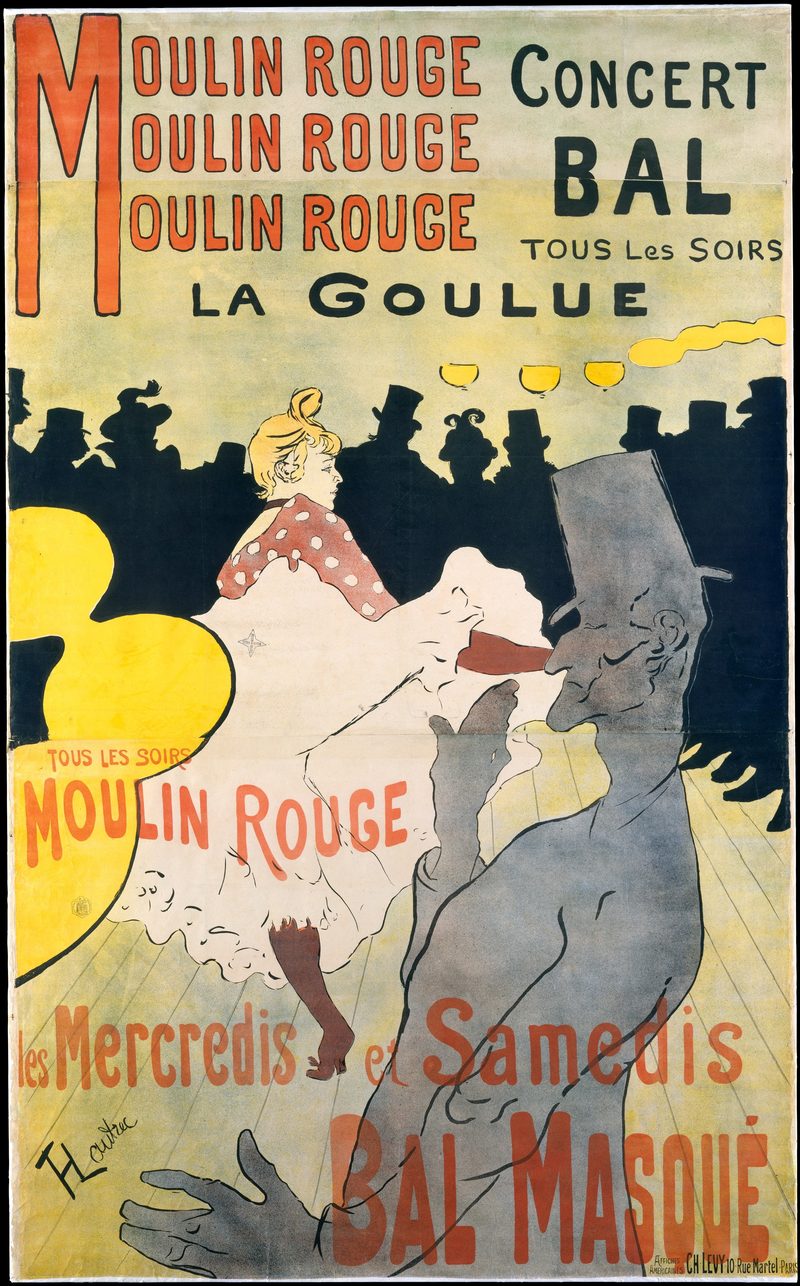
Moulin Rouge: La Goulue
Henri de Toulouse-Lautrec, 1891
Show the style
Bridge card between Impressionism, Iron Architecture ( 9) ↔ Art Nouveau ( 10).
Where to see it
Toulouse-Lautrec Museum
Albi · France
It is a printed poster, so many museums own a copy. Albi, the painter's home town, has the largest collection.
A four-colour lithographic poster (yellow, red, blue and black), 191 × 117 cm, designed by Henri de Toulouse-Lautrec in 1891 to advertise the star dancer Louise Weber, known as “La Goulue” (“The Glutton”), at the Moulin Rouge cabaret in Montmartre. The composition broke the rules of the trade: La Goulue at the centre with her leg up in her famous chahut, the silhouette of the dancer “Valentin le Désossé” seen from behind in the foreground, and a chorus of anonymous shadow figures at the back. With this sheet, the advertising poster began to count as art.
A bridge card between Impressionism and Art Nouveau. From Impressionism it keeps the favourite subject of modern city life (cabaret, dancing, a crowd) and a bold frame cropped like a photograph, close to Degas. The lithograph has given up on atmospheric brushwork, though, and cuts the scene down to silhouettes, black outlines and large fields of flat ink. That Japanese-influenced, decorative composition, made to be reproduced on the streets, opens the door to the Art Nouveau poster.