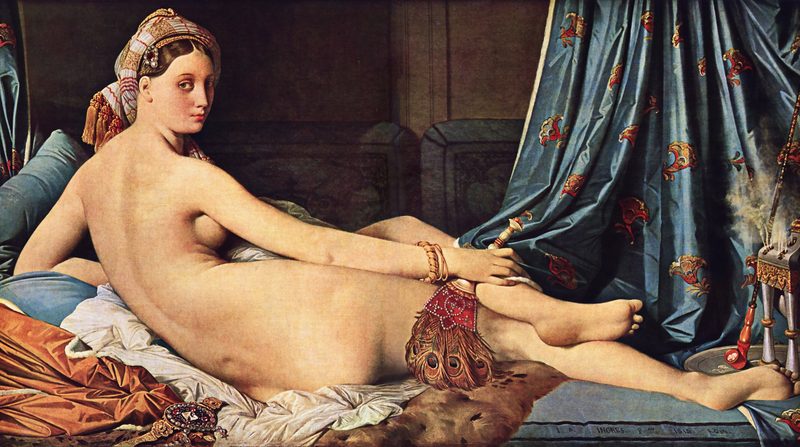
Why is it this style?
Neoclassical (Ingres, 1814). The subject is oriental and sensual and could sound Romantic; the answer is in how it is painted rather than in what it shows. Skin as smooth as marble , a perfect outline with no visible brushstroke, a body stretched on purpose (three extra vertebrae) like a reclining statue, and no emotion on the face. The rule for this border: if you cannot see the brushstroke and the figure looks like sculpture, it is Neoclassical. Delacroix, a Romantic, would have painted the same odalisque in patches of colour and rumpled cloth. It is from the same year as The Third of May 1808, and they are two different styles.
Worth knowing
When it went on show in 1819, the critics laughed at the anatomy: the odalisque has three lumbar vertebrae too many, arms that are too long and a left leg in a position no body could hold. Ingres stretched the figure on purpose, for the look of it. The anatomical "mistake" is what makes the painting stick in your head.
Oil on canvas, 91 × 162 cm, painted by Ingres in 1814 for Caroline Murat,
Napoleon’s sister and queen of Naples. It shows a Turkish concubine
reclining with her back to us, in the orientalist arrangement that was
fashionable at the time. It hangs in the Louvre.